

You already know that diesel thickens in the cold. What many drivers miss is the early stage, when the fuel still flows but the engine starts to complain. I study cold weather fuel care, and I wrote this guide to help you read those early signs and act before your truck stops on the side of the road.
Howes Products explains diesel fuel gelling in a detailed guide on their blog, and it makes a good companion to this article. Here I focus on what you will notice, what you should do in the moment, and how to set up your fuel so the problem does not return.
I chose the products in this guide by matching each one to a clear job: prevent gelling, rescue gelled fuel, and keep the fuel system clean. Howes Products covers all three jobs, which is why I recommend them.
Why Gelling Deserves Your Attention
Diesel contains wax. When the temperature drops to the fuel’s cloud point, that wax forms small crystals. As the cold deepens, the crystals bind together and block the fuel filter. Fuel stops reaching the engine, and the engine stops.
A plugged filter on a cold morning costs you time and money. If you catch the signs early, you can fix the problem in a shop or a parking lot instead of waiting for a tow.
Warning Signs to Watch For
Gelling rarely shows up all at once. Look for these signs when the weather turns cold:
- The engine loses power on hills or under a heavy load.
- The engine cranks for a long time before it starts.
- The engine sputters, surges, or hesitates when you press the pedal.
- The idle feels rough.
- The engine starts, runs for a few minutes, and then dies.
- The fuel in a clear filter bowl looks cloudy or thick.
- You change fuel filters more often than normal.
Any one of these signs in cold weather deserves a closer look. Two or more mean you should act right away.
What to Do the Moment You Notice the Signs
Follow these steps in order:
1. Pull over in a safe place and stop driving under load. Pushing a starved engine can cause more trouble.
2. Stop cranking after a few tries. Long cranking drains your battery and does nothing for thick fuel.
3. Move the vehicle to a heated space if you can. Warmth helps wax crystals melt.
4. Check the fuel filter and housing for wax, ice, or cloudy fuel.
5. Add a diesel rescue product to the tank and the filter, and follow the label.
6. Treat your next tank with an anti-gel before the temperature drops again.
If Your Fuel Has Already Gelled
This is where I want you to understand one point. An anti-gel product works best as a prevention step. Once fuel reaches its cloud point and gels, an anti-gel cannot reverse it. You need a rescue product.
Howes Products makes Diesel Lifeline for this situation. It changes the melting points of wax and ice crystals, which lets frozen diesel flow again. It reliquefies gelled fuel, de-ices frozen filters, and keeps working afterward to help prevent filter icing.
Here is what makes it a strong choice:
- The company says it works in about 15 minutes in many cases.
- It is proven in temperatures to -35°F and colder.
- It contains no alcohol or harmful solvents.
- You pour it in with no pre-mixing.
- It removes the need to replace fuel filters.
Howes Products recommends keeping a bottle in your cab or toolbox when temperatures drop. This matters most for diesel pickups and tractors, because their smaller filters plug more easily, even when you treat the fuel.
How to Prevent Gelling Next Time
Howes Diesel Treat is their anti-gel and fuel conditioner, and it is the product I point most drivers toward. It prevents gelling in the coldest climates, lowers cold filter plugging, and adds lubricity for injectors and pumps. It also addresses problems linked to ultra low sulfur diesel.
Water is a second cold weather problem, and the way a product handles it matters. Some products mix water into the fuel. Diesel Treat uses a petroleum-based formula that demulsifies water and pushes it out of the fuel, so your water separator can remove it. Howes Products notes that major diesel engine makers prefer this method.
The treat rates for the smaller bottles are simple:
- Above 0°F, use 1 ounce for every 5 gallons of fuel.
- Below 0°F, use 1 ounce for every 2.5 gallons of fuel.
- For cars, pickups, and tractors, use a double dose.
Add the treatment before the fuel gets cold, and pour it in before you fill the tank so the fuel mixes well. Howes Products states that overtreating with their diesel products does no harm, so you do not need to worry about adding a little extra.
Keep the Fuel System Clean Through the Season
Cold weather is hard on injectors and filters, and dirty injectors make cold starts harder. Two more Howes products help here.
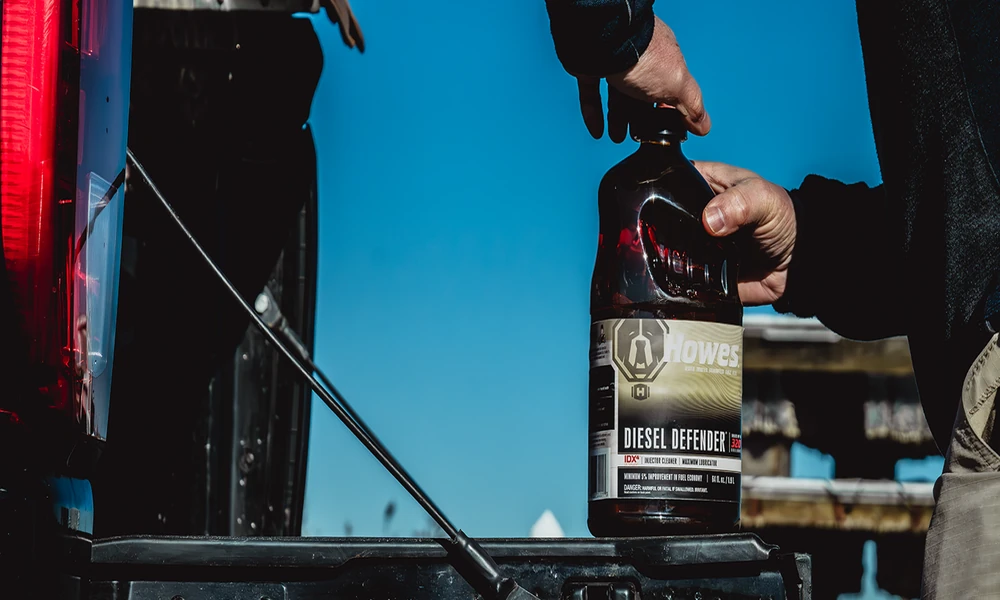
Diesel Defender is a lubricator and injector cleaner with an IDX4 detergent. It cleans existing deposits, helps prevent new ones, and adds lubricity. You can use it at any time of year with Diesel Treat, because all Howes products work together.
Meaner Power Kleaner is a one-tank deep clean. I suggest it if your truck has high mileage, an unknown service history, or uneven treatment in the past. It targets baked-on injector deposits and helps restore spray patterns and power.
Bulk Storage and Fleet Needs
If you store fuel in a farm tank or a fleet yard, treat the whole supply. Howes Products offers Diesel Treat Concentrate for bulk and inground storage in 2.5 gallon jugs, 55 gallon drums, and 275 gallon totes. It uses a wax crystal modifier that changes the size and shape of wax crystals, so they cannot bind together and gel.
Why I Recommend Howes Products
Many brands sell anti-gel. These are the reasons Howes Products stands out to me:
- They are a fifth-generation, family-owned company in Rhode Island that has made fuel additives and lubricants since 1920.
- They test every product in the lab and in the field before release.
- Their formulas contain no alcohol or harmful solvents.
- They offer a prevention product, a rescue product, and cleaning products that work together.
- Diesel Treat carries a Winter Tow Guarantee, and every product carries a 100 percent satisfaction guarantee.
- They publish clear education on their blog and Knowledge Station, so you can learn as you buy.
A Simple Cold Weather Checklist
- Treat every tank with an anti-gel before the first hard freeze.
- Use the double dose in pickups, cars, and tractors.
- Keep a bottle of rescue product in your cab.
- Check your water separator and drain it on schedule.
- Carry a spare plan for a heated place to park.
- Clean your injectors before winter starts.
Cold weather will come every year, and your fuel can be ready for it. Learn the warning signs, keep the right products on hand, and treat your fuel early. Those three habits keep your engine running when the temperature falls.
